Switzerland • Ticino
Tremola Road: Driving the Cobblestone Climb to the Saint Gotthard Pass
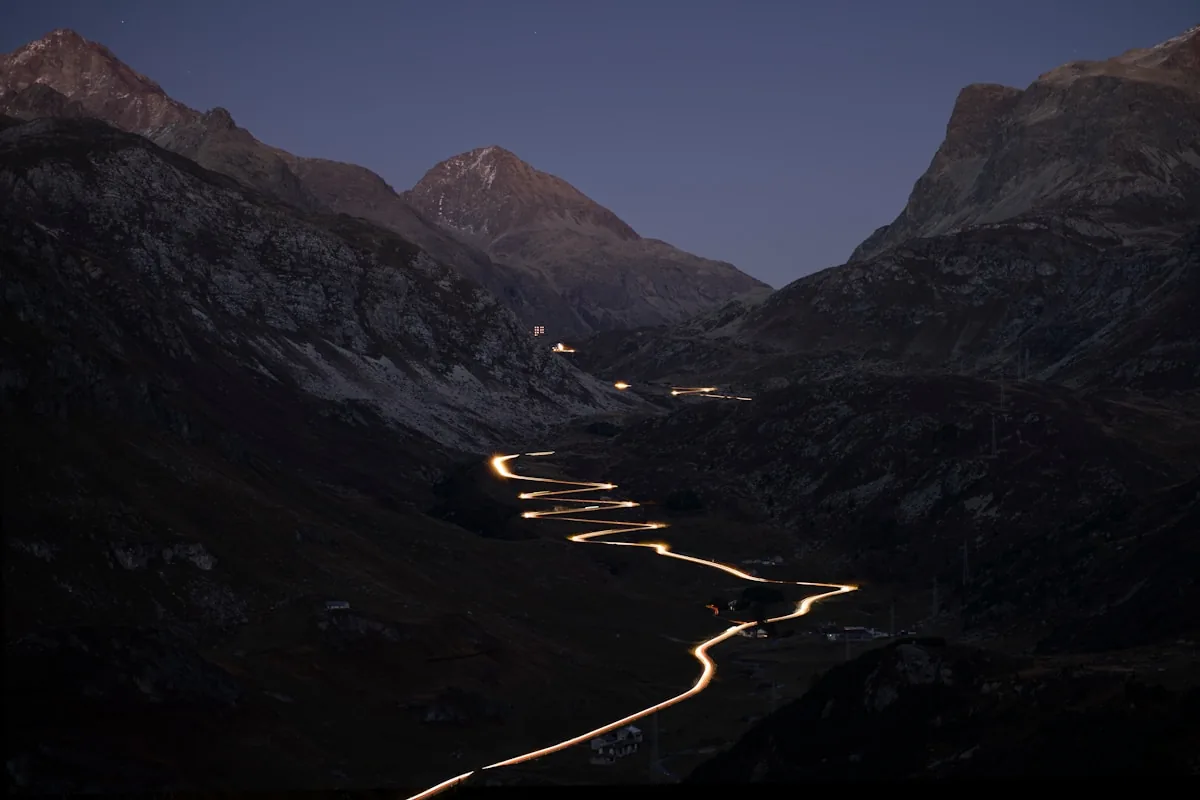
The Tremola (Via Tremola) is the historic cobbled road climbing from Airolo (1,175 m) in Ticino to the Saint Gotthard Pass summit (2,106 m): roughly 13 km and 37 bends — 24 of them stacked hairpins paved with granite cobblestones — with views over the Leventina Valley almost the whole way. It is Switzerland's longest road monument. From the hairpins of the Tremola Road the view opens over the upper Leventina Valley, the deep Ticino valley that begins at Airolo.
Compare options and terms
Drive the Tremola's 24 granite hairpins on your own schedule.
Compare the linked options for your dates. Prices, availability and cancellation terms vary by provider and offer; check the full details before booking.
Last updated: July 2, 2026
Visitor Snapshot
Use this quick summary to make faster booking decisions before you dive into full details.
- Primary destination
- Saint Gotthard Pass
- Nearby airports
- Zurich, Milan, Lugano
- Suggested stay areas
- Andermatt, Airolo, Bellinzona
Tremola Road quick facts
| Start | Airolo (1,175 m), Ticino — A2 exit "Airolo" |
|---|---|
| Ends | Saint Gotthard Pass (2,106 m) |
| Length | ≈13 km (+931 m) |
| Bends | 37 total, 24 named hairpins |
| Surface | Granite setts over ~7 km |
| Traffic | Two-way, 3.5 t limit |
| Open 2026 | 22 May – early November |
| Drive time | ~30 min (2–4 h with summit stops) |
| Toll | Free (Swiss vignette only for the A2 approach) |
What is the Tremola Road?
The Tremola — Via Tremola on the signs — is the historic southern approach to the Saint Gotthard Pass. It climbs about 13 km from Airolo (1,175 m), the last town in the upper Leventina Valley, to the pass summit at 2,106 m, gaining 931 m through 37 bends. The centrepiece is the famous hairpin stack: 24 numbered switchbacks laid one above the other on a single mountainside, all paved in granite setts.
This is the longest road monument in Switzerland. The entire road is listed in the federal inventory of historic routes (IVS), and it is maintained the way a listed building would be — which is why the cobbles feel remarkably even for stone laid in the 1930s and 40s (more on that below).
Since the A2 motorway tunnel opened in 1980, through traffic ignores the mountain entirely, and even most pass traffic uses the parallel asphalt road. That leaves the Tremola to people who came specifically to drive it — on a summer weekday we have had whole sequences of hairpins to ourselves.
Val Tremola: the trembling valley
Tremola means "trembling", and the name belonged to the valley before the road: the Val Tremola is the steep, shaded gully the road climbs, where travelers were said to tremble from the cold and from fear of avalanches. That avalanche exposure is also why the road still closes completely every winter.
One distinction worth fixing in your head before you go: the road climbs the Val Tremola, a small side valley just below the pass, but the big panoramas from the hairpins open over the Leventina Valley — the deep Ticino trench that starts at Airolo and runs away to the south.
Old Tremola vs the new Gotthard road: don't follow your GPS onto the wrong one
Three routes cross or pierce the Gotthard, and navigation apps love the wrong two. The A2 motorway disappears into the 17 km road tunnel at Göschenen — scenic value zero. The "new" pass road, completed in 1977, is a fast sweep of asphalt that bypasses the cobbles entirely. The Tremola is the third option, and you usually have to ask for it by name.
Set your GPS to "Passo del San Gottardo" rather than a through-destination like Lugano or Milan, otherwise it will route you into the tunnel. Climbing from the south, the junction where the old and new pass roads split is at Motto Bartola, just above Airolo — watch for the Tremola signs there. Coming from the north, drive to the pass summit first and take the cobbled descent from the south side of the plateau.
Also on PlanTheAlps
History: a carriage road from 1827, cobblestones from 1937
The carriage road was built between 1827 and 1832 by the Ticino engineer Francesco Meschini, as part of the great upgrade of the Basel–Chiasso road that turned the mule track over the Gotthard into a route wheeled traffic could actually use. Mail coaches, freight and the first generation of Alpine tourists all came up this way.
One correction to a claim you will read everywhere: many guides say the cobbles date to 1827 — the road does; today's granite setts were laid 1937–41. The Tremola's present appearance owes most to the 1951 reconstruction, and the whole road was carefully restored between 2009 and 2011. So you are driving an 1830s alignment on twentieth-century stone — no less atmospheric, but worth getting right.
- 1237 — a hospice at the pass is first recorded; travelers have sheltered up here ever since
- 1775 — first carriage crossing of the Gotthard
- 1827–1832 — Meschini's carriage road is built through the Val Tremola
- 1895 — the first car crosses the pass
- 1937–1941 — the granite paving is laid
- 1951 — the reconstruction that gives the road its present appearance
- 1977 — the new asphalt pass road opens on the south side, bypassing the Tremola
- 1980 — the A2 Gotthard road tunnel opens; through traffic leaves the mountain, and the Tremola has been nearly car-free ever since
- 2009–2011 — full restoration of the historic road
Driving the Tremola in 2026
Everything below applies to the 2026 season; the pattern repeats most years, give or take a snowfall.
Opening dates and winter closure
The Tremola opened for the 2026 season on 22 May; the main Gotthard pass road opened earlier, on 8 May. Both usually stay open until the first heavy snow around early November, and the pass is then snowbound from roughly November to mid-May. The cobbled road is always the last to open and the first to close, so double-check 2026 Swiss pass opening dates before an early- or late-season trip.
Up or down? Choosing your direction
Descending from the pass toward Airolo gives the most dramatic views: the hairpins drop away beneath you and you look straight down the stack with the Leventina Valley beyond. Climbing from Airolo is easier on the nerves — you hug the mountainside and watch the wall of cobbles rise ahead rather than the drop. Switzerland Tourism recommends driving the pass north to south, which puts the Tremola on your descent, and that is our preference too. Based in Andermatt? Simply drive it both ways.
Road surface and which vehicles can drive it
The granite setts are well maintained — this is a listed monument, not a forgotten farm track — but they are still stone: bumpy at any speed and noticeably slippery when wet. Drive at 20–30 km/h and brake gently before the bends, not in them.
Any normal car or rental handles the Tremola without drama, and campers are fine under the 3.5-tonne limit. Lowered cars risk scraping. And no, the road is not one-way: it carries two-way traffic with a 3.5 t weight limit, so expect the occasional oncoming car or group of cyclists on the hairpins.
How long does it take?
Around 25–40 minutes for the climb or descent itself, depending on how often you pull over. As a visit, budget 2–4 hours: the photo stops on the hairpins, the museums and lakes at the summit, and a coffee at the hospice absorb time quickly.
Parking
There is parking in Airolo, small pull-offs at intervals on the climb (use them for photos rather than stopping on the bends), and a large parking area at the summit just off the main road, a short walk from the hospice, the museums and the lakes.
The views: Leventina Valley and the hairpin stack
Which valley do you see from the Tremola Road?
The upper Leventina Valley. From the hairpins the view opens over the upper Leventina — the deep, glacier-carved Ticino valley that begins at Airolo and carries the motorway and railway south toward Bellinzona. The road itself climbs the Val Tremola, a small side valley of the pass, so the valley you are driving in and the valley you are looking at have different names — a favourite trick distinction in online quizzes.
Best photo stops
- First-bend viewpoint on the descent — leaving the summit southbound, the first pull-off looks straight down the staircase of bends
- The mid-Tremola hairpin stack — the classic look-back at all 24 stacked bends climbing the wall above you; the stacked section gains about 300 m in just 4 km
- Lower pull-off near Airolo — from near the bottom you can trace the entire route back up the mountainside
- The summit lakes — Lago della Piazza and its neighbours make calm foregrounds for pass photos, minutes from the parking
Tremola by motorcycle and bicycle
Motorcyclists love the Tremola — it is one of the classic historic climbs of the Alps — but the setts transmit heavy vibration through the bars, and wet stone demands real caution and gentle inputs. Ride it for the experience, not for pace; the asphalt pass road next door is the one for lean angles.
For cyclists this is a legend: 12.7–13 km from Airolo with about 930 m of gain at an average of 7.3–7.6%, and ramps above 10% in the hairpins. The Tour de Suisse has made the climb famous, and the near-total absence of cars makes it one of the most enjoyable hard climbs in Switzerland. Strong riders often fold it into a multi-pass day with the Furka, Nufenen or Susten.
At the top: the Gotthard Pass summit (2,106 m)
The pass summit is a small world of its own. The Ospizio San Gottardo — a hospice first recorded in 1237 — still stands at the top and today operates as a hotel and restaurant, so you can even sleep at the summit and have the Tremola to yourself at dawn.
- Museo Nazionale del San Gottardo — the national pass museum, open daily from June to the end of September, 9:00–18:00
- Sasso San Gottardo — a museum inside a former artillery fortress dug into the granite of the pass
- Lago della Piazza and the nearby dam lakes — short, flat walks from the parking area
- Restaurants and parking — just off the main road at the summit
Getting there & combining passes
From the north, take the A2 from Zurich or Lucerne toward Göschenen and Andermatt, then follow the pass road south over the summit; our guide to driving Zurich Airport to Andermatt (130 km, about 1.5 h) covers the approach. From the south, leave the A2 at the "Airolo" exit — the Tremola starts practically at the ramp.
The Tremola is only the cobbled southern climb; for the whole crossing — Andermatt, the summit and both descents — read our full Gotthard Pass drive guide.
The Gotthard also sits at the hub of Switzerland's best pass-driving country. Combine it with the Furka and Grimsel loop (or compare them in our Furka vs Grimsel guide) for a classic one-day circuit, add the Susten Pass for the full three-pass day, or drop west over the Nufenen into the Valais. Opening dates differ from pass to pass, so check the live Swiss pass opening dates while planning.
Where to stay
Andermatt is the natural base on the north side. It sits at the hub of five passes — Gotthard, Furka, Grimsel, Susten and Oberalp — so two nights let you drive the Tremola one day and loop the others the next. See our full guide to where to stay in Andermatt.
On the south side, Airolo puts you at the very foot of the hairpins — handy for an early, empty run up the cobbles — while Bellinzona, about 45 minutes down the Leventina Valley, is the Ticino capital with more hotel choice and lower prices.
Frequently Asked Questions
Which valley offers views from Tremola Road?
From its hairpins the view opens over the upper Leventina Valley toward Airolo; the road itself climbs the Val Tremola, a small side valley of the pass.
What type of surface covers Tremola Road's hairpin bends?
Granite cobblestones (setts) laid 1937–1941 on the 1827 carriage road, renewed in the 1951 reconstruction — about 7 km of continuous paving.
Which Swiss mountain pass is reached via Tremola Road?
The Saint Gotthard Pass (Passo del San Gottardo), 2,106 m, between Airolo (Ticino) and Andermatt (Uri).
How many hairpin bends does the Tremola Road have?
24 named hairpins out of 37 bends in total; the famous stacked section gains ~300 m in just 4 km.
When is the Tremola Road open in 2026?
It opened 22 May 2026 and usually stays open until the first heavy snow in early November. The main pass road opened 8 May 2026.
Is the Tremola Road one-way?
No — two-way traffic with a 3.5 t weight limit.
Can I drive the Tremola in a normal rental car?
Yes. Take it at 20–30 km/h, avoid wet days if you can, and mind ground clearance on lowered cars.
Where does the Tremola Road start?
In Airolo (1,175 m), the last town in the upper Leventina Valley — A2 motorway exit "Airolo".
How long does the Tremola drive take?
About 30 minutes for the climb itself; allow 2–4 hours with photo and summit stops.
Plan Your Trip Further
Scenic Drives
Where to Stay
Itineraries
Planning a full Switzerland road trip? Our complete hub guide covers routes, bases, driving rules, and sample itineraries.
See the complete guide →Help Us Help You
Tell us what would make this guide more useful for your trip.
We want every PlanTheAlps page to save you time, reduce stress, and help you make better travel decisions. Share what feels unclear, missing, or outdated, and we will use your feedback to improve the site for all visitors.
You are sharing feedback on: Tremola Road: Driving the Cobblestone Climb to the Saint Gotthard Pass