Switzerland • Swiss driving rules and safety
Switzerland Speed Limits and Driving Fines: Practical Rules for US and UK Tourists
A clear, practical guide to Swiss speed-limit expectations and fine-risk reduction for self-drive travelers planning Alps road trips.
Compare prices before you go
Avoid fines — drive a car with built-in guidance.
Compare the linked options for your dates. Prices, availability and cancellation terms vary by provider and offer; check the full details before booking.
Last updated: July 28, 2026
Visitor Snapshot
Use this quick summary to make faster booking decisions before you dive into full details.
- Primary destination
- Switzerland
- Nearby airports
- Zurich, Geneva, Basel
- Suggested stay areas
- Lucerne, Interlaken, Montreux
Quick Answer
- ✓Limits: 50 km/h in towns, 80 km/h on open roads, 100 km/h on expressways, 120 km/h on motorways
- ✓Motorway fixed fines start at CHF 20 (1–5 km/h over) and reach CHF 260 at 21–25 km/h over
- ✓In a 50 km/h town the same excess costs more: CHF 40, CHF 120 and CHF 250 for 5, 10 and 15 km/h over
- ✓Go far enough over and it stops being a ticket: the case goes to court and the fine is set from your income
- ✓Rental-car fines reach you by post months later, plus the rental company's admin fee
The short answer for road-trip visitors
Switzerland has four default speed limits: 50 km/h in built-up areas, 80 km/h on ordinary roads outside towns, 100 km/h on expressways (Autostrasse) and 120 km/h on motorways (Autobahn) — both are signed in green, so read the entry pictogram rather than the colour. Many residential streets are signed at 30 km/h, and some town centres at 20 km/h. The posted sign always wins over the default.
Minor excesses are handled as fixed penalties you simply pay. They are cheapest on the motorway and most expensive in town, because the same speed is more dangerous where people walk:
| Over the limit | Motorway | Open road (80) | In town (50) |
|---|---|---|---|
| 1–5 km/h | CHF 20 | CHF 40 | CHF 40 |
| 6–10 km/h | CHF 60 | CHF 100 | CHF 120 |
| 11–15 km/h | CHF 120 | CHF 160 | CHF 250 |
| 16–20 km/h | CHF 180 | CHF 240 | Court case |
| 21–25 km/h | CHF 260 | Court case | Court case |
Above those brackets the fixed-penalty system stops applying. The case goes to a prosecutor, the fine is calculated from your income and assets as day-fines, and your licence can be withdrawn — including for visitors, as a ban on driving in Switzerland. This is why Swiss speeding cases occasionally produce five-figure fines for high earners.
The most serious tier is the Raser offence: roughly 50 km/h over in a 50 zone, 60 km/h over on an 80 road, or 80 km/h over on a motorway. That carries a prison sentence of up to four years, a long licence ban, and the car itself can be confiscated — a rental car included.
Enforcement is heavily automated: fixed cameras, mobile units and average-speed sections in tunnels. If you are driving a rental car, the penalty notice goes to the rental company first, which charges you an administration fee and passes on your details; the fine itself then arrives by post, often two to four months after the trip.
How speed limits usually change across environments
The general 50 km/h limit starts at the round «50 generell» sign posted where the built-up area begins — usually right beside the place-name board (blue on main roads, white on minor roads) — and ends at the «Ende 50 generell» sign. Visitors are caught most often in the few hundred metres after that board, on a road that still looks rural.
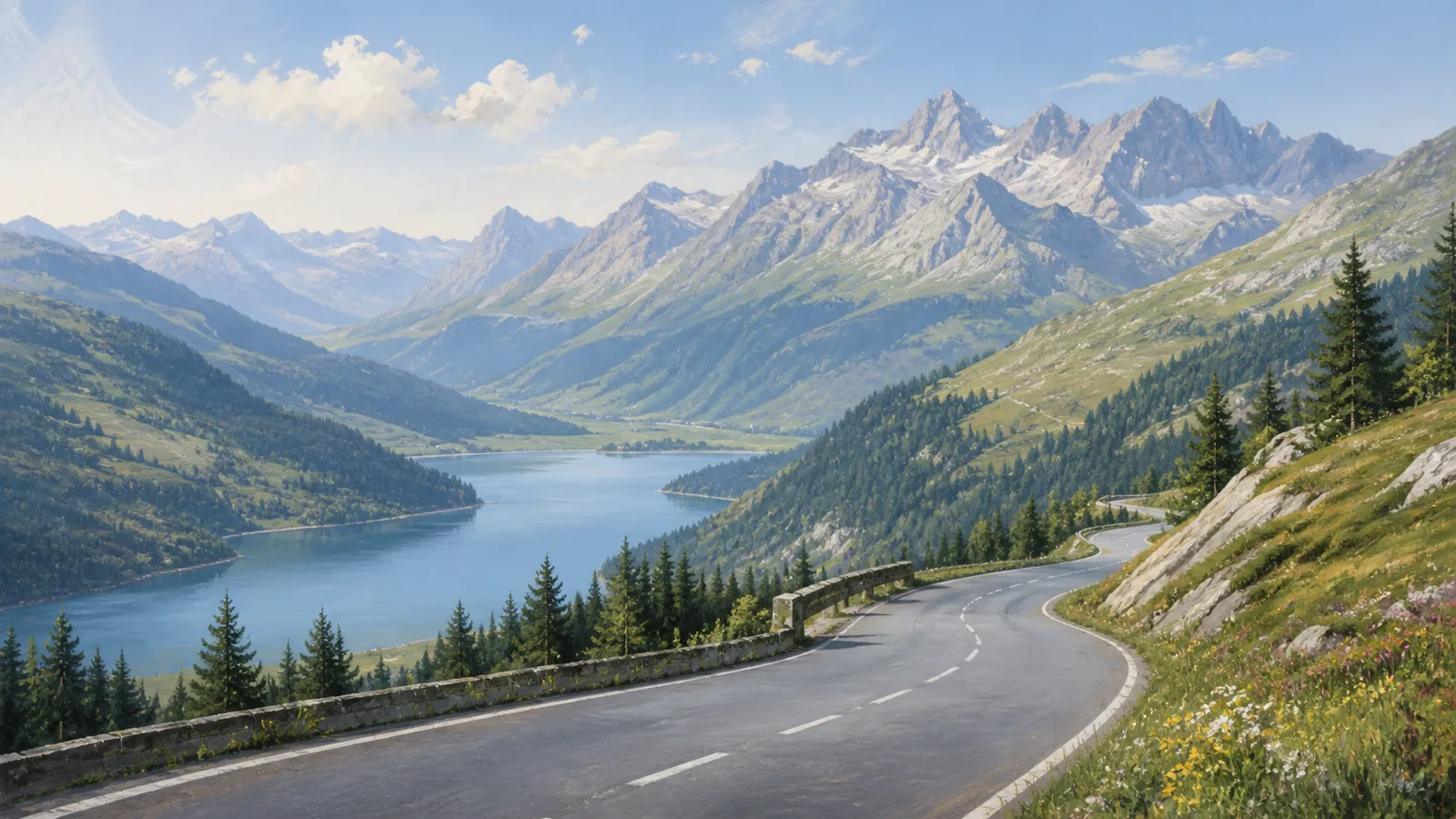
Pass roads carry the 80 km/h open-road limit, but that is a ceiling, not a target — most hairpin sections are comfortable at 30–50 km/h, and Swiss drivers behind you will expect you to use the pull-outs to let them past.
Tunnels frequently drop to 80 km/h and several long ones are monitored by average-speed cameras, so braking for a single camera does not help. Lights are compulsory at all times in Switzerland: daytime running lights suffice in daylight, but you must switch to dipped headlights in tunnels, in poor visibility (rain, fog, snowfall) and from dusk to dawn (fixed fines start at CHF 40).
Camera enforcement and visitor mistakes
One frequent mistake is carrying highway speed habits into short village sections. Another is accelerating too early before a higher-limit zone begins.
Most avoidable penalties happen in transition zones, not on dramatic passes. Drive one level calmer than you think you need.
Consistent lane discipline and smooth speeds also reduce fatigue on long scenic days.
Also on PlanTheAlps
Risk-reduction system for US and UK drivers
Set your rhythm early: moderate speed, longer following distance, and deliberate braking before villages. This keeps your route safer and your planning intact.
On unfamiliar roads, prioritize predictability over pace. Arriving 20 minutes later is better than carrying fine risk through your itinerary.
Treat speed discipline as part of budget protection. Fewer penalties means more room for experiences you planned the trip for.
Pre-drive checklist before your first Swiss transfer day
Confirm your route, rest after long-haul arrival, and avoid late-day rushed driving. Fatigue and unfamiliar signage are the biggest first-day risk combination.
Keep contracts and emergency numbers easy to access. If anything happens, clarity lowers stress and decision time.
When in doubt, slow down and keep distance. This single rule solves most first-week driving errors.
Frequently Asked Questions
Are Swiss speed limits strictly enforced?
Yes. Enforcement is consistent, and automated systems are common in many areas.
Do tourists get fined in Switzerland for small speed violations?
Yes, visitors can receive penalties. The safest approach is strict compliance with posted limits.
Where do visitors most often make speed mistakes?
Transition zones around villages and mixed road sections are the most common problem areas.
Should I trust app speed suggestions over road signs?
No. Navigation apps help, but the posted roadside sign is the legal reference you must follow.
What is the best way to avoid fines on a Swiss road trip?
Drive conservatively, anticipate lower limits before settlements, and prioritize smooth, predictable speeds over fast progress.
Plan Your Trip Further
Scenic Drives
Where to Stay
Itineraries
Planning a full Switzerland road trip? Our complete hub guide covers routes, bases, driving rules, and sample itineraries.
See the complete guide →Help Us Help You
Tell us what would make this guide more useful for your trip.
We want every PlanTheAlps page to save you time, reduce stress, and help you make better travel decisions. Share what feels unclear, missing, or outdated, and we will use your feedback to improve the site for all visitors.
You are sharing feedback on: Switzerland Speed Limits and Driving Fines: Practical Rules for US and UK Tourists